
Medically reviewed by Anand Thakkar, MD. Last updated: October 6, 2026.

Testosterone pellets vs injections is one of the first decisions men face after a low T diagnosis. Creams and gels are a third option. All three deliver the same hormone. What differs is how often you dose, how steady your levels are, how easily the dose can change and which side effects are more likely.
For treatment in Chicago, see testosterone replacement therapy in Chicago.
This guide compares them side by side, so you can walk into your appointment knowing what to ask. It’s general information, not a recommendation. Your labs, health history and preferences decide what fits you.
In This Article
- Testosterone Pellets vs Injections vs Cream at a Glance
- How Each Form of Testosterone Works
- Steady Levels vs. Peaks and Valleys
- Side Effects: Pellets vs Injections vs Cream
- Which Form Fits Your Life?
- Cost: Testosterone Pellets vs Injections
- Can You Switch Between Forms?
- Questions to Ask Before You Choose
- What Doesn’t Change: Fertility and Monitoring
- How We Help You Choose at Bliss MD
- Testosterone Pellets vs Injections: FAQs
- Compare Your Options in Person
Testosterone Pellets vs Injections vs Cream at a Glance
| Injections | Pellets | Creams or gels | |
|---|---|---|---|
| How it’s given | Ours: just under the skin, in MCT oil. Traditional (into the muscle) for some patients | Tiny pellets placed under the skin in the office | Rubbed onto the skin (our compounded cream: the scrotum) |
| How often | Ours: twice a week, at home | Commonly every few months, depending on labs | Daily |
| Levels | Traditional shots: rise, then fall. Smaller twice-weekly doses aim for steadier levels | Steadier; higher early, then taper | Fairly steady day to day |
| Changing the dose | Easy | Wait until the next insertion | Easy |
| Procedure | None (or a quick clinic visit) | Small in-office procedure each time | None |
| Transfer to others | No | No | Yes, unless covered |
| FDA-approved options | Yes; our compounded MCT-oil injections are not | We use compounded pellets only; compounded pellets are not | Commercial gels are; compounded creams are not |
The short version of testosterone pellets vs injections: pellets trade flexibility for convenience. Injections trade convenience for control. All three are available at both of our clinics, Lincoln Park and Hanover Park.
How Each Form of Testosterone Works
Injections
Testosterone cypionate and enanthate are the most common injections. Traditional versions are oil-based, often in cottonseed or grapeseed oil, and given into a muscle. Many men find them harder to give. A long-acting injection given in the clinic every few months also exists, with a short observation period after each shot.
At Bliss MD, we now offer subcutaneous testosterone injections in medium-chain triglyceride (MCT) oil, not grapeseed, canola or cottonseed oil. You give a small shot just under the skin twice a week at home, after we show you how.
These MCT-oil injections are compounded only, and compounded products are not FDA-approved. If you’re comparing testosterone pellets vs injections at Bliss MD, this is the newer injection option we offer. For some patients, we also offer traditional intramuscular injections.
Pellets
Pellets are about the size of a grain of rice. They’re placed in the fat under the skin of the hip or upper buttock through a tiny, numbed opening.
We use only compounded pellets, from a carefully selected, high-quality compounding pharmacy. Compounding lets us use cholesterol as the filler and add an estrogen blocker only when your labs call for it. In our experience, rates of extrusion and infection are very low. Learn more on our testosterone pellets for men page.
Creams and Gels
FDA-approved gels go on the shoulders, arms or thighs once a day and come in set strengths, such as 1.62%. Our compounded cream is applied to the scrotum, and its strength can be adjusted, for example to 5%, 10% or up to 20%, to reach your optimal level. Compounded creams aren’t FDA-approved.
Other Options
FDA-approved oral capsules and a nasal gel are also available. They’re used less often, and oral products carry a blood pressure warning on their labels.
Steady Levels vs. Peaks and Valleys
How your levels move over time is a big part of the testosterone pellets vs injections choice, and it’s the difference men notice most.
- Traditional injections: levels rise for a day or two after each shot, then drift down until the next one. These peaks and troughs are one reason some patients prefer pellets. Some men notice lower energy or mood near the end of the cycle.
- Subcutaneous injections: smaller doses twice a week aim to keep levels steadier between shots.
- Pellets: testosterone is released slowly over months. Levels are steadier day to day, a bit higher in the first weeks, then taper.
- Creams and gels: daily use keeps levels fairly even, as long as you apply them consistently.
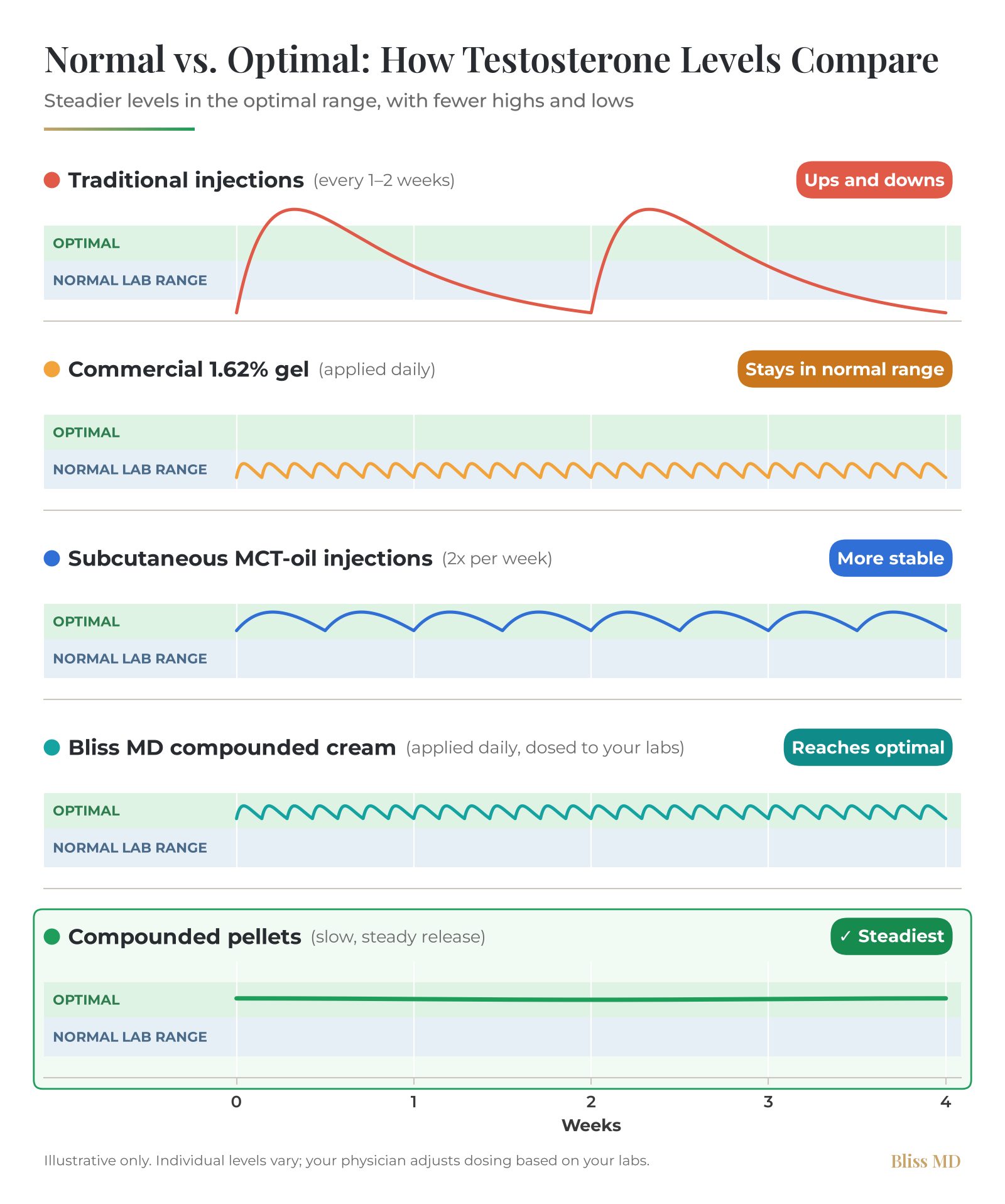
None of these patterns is wrong. What matters is how you feel and what your labs show over time. When you weigh testosterone pellets vs injections, our goal is your optimal level, not just a “normal” number.
Side Effects: Pellets vs Injections vs Cream
All testosterone can cause acne, breast tenderness, ankle swelling, worse sleep apnea and a lower sperm count. Some risks differ by form.
Red Blood Cells (Hematocrit)
Testosterone can thicken the blood. In a study of men on each form, hematocrit above 50% occurred in about 67% of men on injections, 35% on pellets and 13% on gels (Pastuszak et al.). The men on injections were also younger with higher starting levels, so it isn’t a perfect comparison. The Endocrine Society guideline advises pausing treatment if hematocrit rises above 54%.
Site Reactions
Injections can cause soreness at the injection site. Pellet insertion can cause bruising and, less often, infection or a pellet working its way out. In our experience, those last two are very low with our compounded pellets. Creams can irritate the skin.
Transfer to Others
Only creams and gels can rub off on a partner or child. Let the skin dry, cover it and wash your hands. This risk is one reason some men choose testosterone pellets vs injections or gels.
Which Form Fits Your Life?
For most men, testosterone pellets vs injections comes down to routine. Here’s a simple way to think about it.
Injections May Fit If You…
- Want the most control over your dose
- Are comfortable with a small shot under the skin twice a week
- Are just starting and need room to adjust
Pellets May Fit If You…
- Want fewer appointments and no daily routine
- Travel often or have a busy schedule
- Already have stable labs on another form
Creams May Fit If You…
- Prefer no needles and no procedures
- Want steady day-to-day levels
- Can keep treated skin away from others

Cost: Testosterone Pellets vs Injections
When it comes to price, testosterone pellets vs injections usually look like this: generic injections have the lowest medication cost. Pellets usually cost more per visit, because each insertion is a procedure, but you need fewer visits. Brand gels can cost more without insurance. Over a year, the gap depends on your dose and schedule. Read TRT cost in Chicago for the seven factors that shape the price.
Can You Switch Between Forms?
Yes. Many men start with injections or a cream to find the right dose, then move to pellets once their labs are stable. Others start with pellets and switch to injections for more control. If you’re weighing testosterone pellets vs injections, there’s no need to decide forever.
We time any switch so your levels don’t dip too low or stack up. We also recheck labs after the change.
Questions to Ask Before You Choose
Bring these to your appointment. They turn testosterone pellets vs injections from a sales choice into a medical one:
- What do my labs show? Your total and free testosterone, hematocrit and PSA shape the options.
- How would my dose be adjusted on each form? With pellets, changes wait until the next insertion.
- Which side effects should I watch for on each form? Ask what would make you call the clinic.
- Is the product FDA-approved or compounded? Ours are compounded, and we’ll explain why.
- What happens if I want to stop or switch? You should hear a clear plan.
- How does this affect fertility? Ask before your first dose, not after.
If you’re still unsure your symptoms come from low T, start with our guide to low testosterone symptoms.
What Doesn't Change: Fertility and Monitoring
Whatever you choose, two things stay the same:
- Fertility: every form of testosterone can lower sperm production, sometimes to zero. If you may want children, tell us before you start so we can discuss other options.
- Monitoring: testosterone, hematocrit, PSA, estradiol and blood pressure are checked on a schedule your physician sets.
In 2025, the FDA updated testosterone labels with results of the TRAVERSE trial. Read more in is TRT safe?
How We Help You Choose at Bliss MD
The testosterone pellets vs injections decision is made together, with your labs in front of us. Dr. Thakkar reviews your levels, hematocrit, PSA, health history and daily routine, then explains the trade-offs of each option. We offer subcutaneous injections, compounded pellets and compounded cream at both clinics, so the choice is about you, not what we stock.
The goal is optimal, not just normal. Dr. Thakkar doesn’t want you to settle for a normal life. Whichever form you choose, dosing is individualized to aim for the effects you want while minimizing side effects.
Learn more about testosterone replacement therapy in Chicago, or see our page for TRT in Schaumburg.

Testosterone Pellets vs Injections: FAQs
Are testosterone pellets better than injections?
Neither is better for everyone. Pellets mean fewer visits; injections are easier to adjust. The right choice depends on your labs, your schedule and how you feel on treatment.
Which raises red blood cells more, pellets or injections?
In one study comparing men on each form, high hematocrit was most common with injections, less common with pellets and least common with gels. Every form needs monitoring.
How often do you need testosterone pellets vs injections?
At Bliss MD, our subcutaneous injections are given twice a week at home. Pellets are commonly placed every few months, depending on your labs. Our compounded cream is applied daily.
Can I switch from injections to pellets?
Yes. Many men start on injections or a cream to find their dose, then switch to pellets once their labs are stable. We time the switch so your levels don’t dip or overlap.
Is testosterone cream as effective as injections?
For many men, creams and gels raise testosterone into a healthy range. Absorption varies from person to person. Our compounded cream goes on the scrotum, and its strength can be adjusted, for example from 5% to 20%, so we check your labs and fine-tune it.
Why do some men prefer pellets over injections?
In the testosterone pellets vs injections choice, traditional oil-based injections make levels rise after each shot and fall before the next. Some men feel those ups and downs. Pellets release testosterone slowly, so levels are steadier. Our twice-weekly subcutaneous injections are another way to aim for steadier levels.
Do pellets or injections affect fertility differently?
No. All forms of testosterone can lower sperm production, sometimes to zero. If you may want children, tell us before you start.
Which is less expensive, pellets or injections?
Injections usually cost less for the medication. Pellets usually cost more per visit but need fewer visits. See TRT cost in Chicago for the factors.
Compare Your Options in Person
Book a free 15-minute discovery call, then visit our Lincoln Park clinic in Chicago or our Schaumburg-area clinic in Hanover Park. Prefer the phone? Call (630) 289-0440.
Bliss MD – Lincoln Park
2707 N Halsted St, Chicago, IL 60614
Phone: (630) 289-0440 · Open in Maps
Bliss MD – Hanover Park (Schaumburg Area)
1802 Irving Park Rd, Hanover Park, IL 60133
Phone: (630) 289-0440 · Open in Maps
Sources
- Bhasin S, et al. Testosterone Therapy in Men With Hypogonadism: An Endocrine Society Clinical Practice Guideline. J Clin Endocrinol Metab. 2018. academic.oup.com
- Pastuszak AW, et al. Comparison of the Effects of Testosterone Gels, Injections, and Pellets on Serum Hormones, Erythrocytosis, Lipids, and PSA. Sex Med. 2015;3(3):165–173. pubmed.ncbi.nlm.nih.gov
- U.S. Food and Drug Administration. FDA Issues Class-Wide Labeling Changes for Testosterone Products. February 28, 2025. fda.gov
This article is educational and is not a substitute for medical advice.
